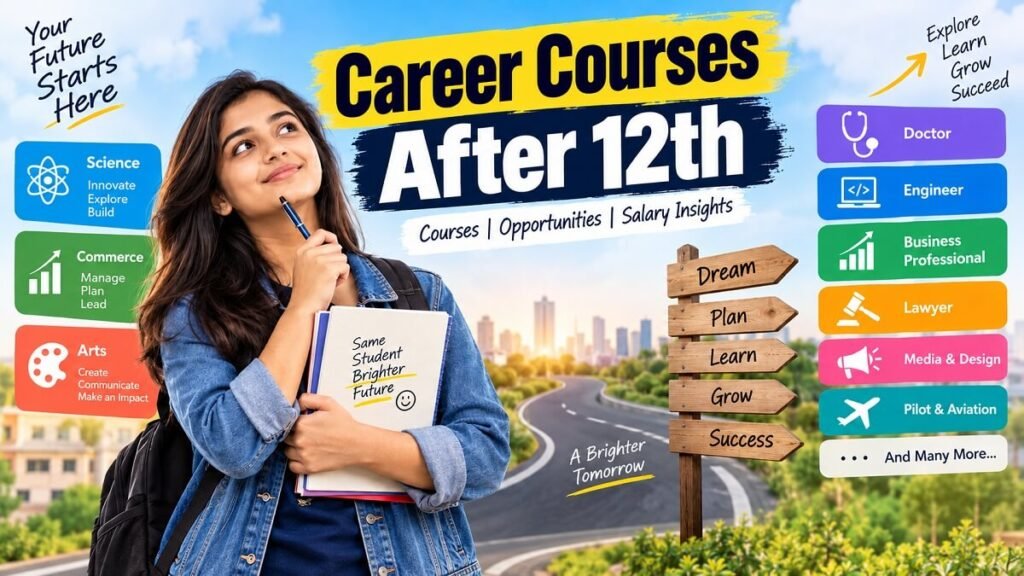
Choosing the right career course after 12th is one of the biggest decisions students make after completing Higher Secondary. With hundreds of courses available across Science, Commerce, Arts and professional fields, it is completely normal to feel confused about what to choose.
Should you pursue a career in engineering or medicine? Is a B.Com. superior to a BBA? Can students in the arts pursue lucrative careers? If you don’t want to pursue a traditional degree, what are the best career options after 12th grade?
The right course is not necessarily the one with the highest salary. It should match your interests, abilities, career goals, budget and future job opportunities.
This guide will discuss emerging career fields, expected salary ranges, job opportunities, popular options for Science, Commerce, and Arts students, the best career courses after 12th grade, and crucial factors to take into account before making a decision.
Table of Contents
How to Choose a Career After 12th
There is no single “best career” for every student. A course that works well for one student may not be the right choice for another.
Before applying for a course, think about these questions:
- Which subjects do I actually enjoy studying?
- What are my strongest skills?
- Do I prefer a job, business, research or creative career?
- How much can I realistically spend on education?
- What kind of work environment do I prefer?
- Does the course offer good career opportunities?
- Will I need higher education after completing the course?
- What skills will I need to become employable?
A useful way to think about career selection is:
Interest + Ability + Career Opportunities + Affordability = Better Career Decision
Do not choose a course simply because your friends are choosing it or because someone says it has a high salary.
Best Career Courses After 12th Science
After Higher Secondary, science students have many options. Depending on whether you studied PCM (Physics, Chemistry and Mathematics) or PCB (Physics, Chemistry and Biology), you have a variety of options, including pure sciences, computer applications, engineering, medicine, healthcare, and several emerging fields.
Popular Courses After 12th Science
| Course | Duration | Popular Career Options | Approx. Starting Salary |
|---|---|---|---|
| B.Tech / Engineering | 4 years | Software Engineer, Civil Engineer, Mechanical Engineer | 4–10 LPA |
| MBBS | 5.5 years | Doctor, Medical Officer | 6–20 LPA |
| BDS | 5 years | Dentist, Dental Surgeon | 4–10 LPA |
| B.Sc Nursing | 4 years | Staff Nurse, Nursing Officer, Hospital Professional | 3–8 LPA |
| B.Pharm | 4 years | Pharmacist, Medical Representative, Research Professional | 3–7 LPA |
| BCA | 3 years | Software Developer, Web Developer, IT Professional | 3–8 LPA |
| B.Sc. Computer Science | 3–4 years | Developer, System Administrator, IT Analyst | 3–8 LPA |
| B.Sc. Data Science | 3–4 years | Data Analyst, Data Scientist | 4–12 LPA |
| Biotechnology | 3–4 years | Research Assistant, Biotechnologist | 3–8 LPA |
| Architecture | 5 years | Architect, Urban Designer | 4–10 LPA |
The salary figures are only estimates and can vary greatly based on experience, employer, location, college, and skills.
Engineering and Technology
B.Tech or BE remains one of the most popular choices for students with a PCM background.
Engineering is no longer limited to traditional branches such as Civil or mechanical engineering. Students can also explore:
- Computer Science Engineering
- Information Technology
- Artificial Intelligence and Machine Learning
- Data Science
- Electronics and Communication
- Electrical Engineering
- Robotics
- Cyber Security
Students interested in technology should also focus on practical skills such as programming, problem-solving, communication and project development.
Explore Engineering Colleges: Click Here
Medical and Healthcare Courses
Students with PCB subjects can consider several healthcare careers.
Popular options include:
- MBBS
- BDS
- B.Sc. Nursing
- B.Pharm
- Physiotherapy
- Medical Laboratory Technology
- Radiology and Medical Imaging
- Biotechnology
- Occupational Therapy
- Optometry
MBBS is not the only route into healthcare. Many allied health and paramedical professions also provide meaningful career opportunities.
Explore Medical & Health Science Colleges: Click Here
Computer and IT Courses After 12th Science
If you enjoy computers and technology, you do not necessarily need to pursue engineering.
Other options include:
- BCA
- B.Sc Computer Science
- B.Sc Information Technology
- Data Science
- Artificial Intelligence
- Cyber Security
- Cloud Computing
- Web Development
The degree is just one aspect of the path for students pursuing careers in technology. Projects, internships, coding proficiency, and real-world experience can all have a significant impact.
Explore Computer Science Colleges: Click Here
Best Career Courses After 12th Commerce
Commerce is an excellent stream for students interested in finance, accounting, business, management, banking and entrepreneurship.
You can choose a traditional degree such as B.Com or combine a graduation course with professional qualifications such as CA, CS or CMA.
Popular Courses After 12th Commerce
| Course | Duration | Career Options | Approx Salary Range |
|---|---|---|---|
| B.Com | 3 years | Accountant, Finance Executive, Tax Assistant | 3–6 LPA |
| BBA | 3 years | Management Executive, HR Executive, Business Development | 4–10 LPA |
| Chartered Accountancy (CA) | Varies | Chartered Accountant, Auditor, Tax Consultant | 7–25 LPA |
| Company Secretary (CS) | Varies | Company Secretary, Compliance Professional | 6–15 LPA |
| CMA | Varies | Cost Accountant, Financial Analyst | 5–15 LPA |
| Banking & Finance | 3 years | Banking Professional, Finance Executive | 4–10 LPA |
| Economics | 3 years | Economist, Analyst, Research Professional | 4–10 LPA |
| Hotel Management | 3–4 years | Hotel Executive, Hospitality Manager | 3–12 LPA |
| Digital Marketing | 6–12 months+ | SEO Executive, Digital Marketer, Social Media Manager | 3–10 LPA |
B.Com: A Flexible Choice for Commerce Students
Bachelor of Commerce (B.Com) is one of the most popular undergraduate courses after 12th Commerce.
It can lead to careers in:
- Accounting
- Banking
- Finance
- Taxation
- Insurance
- Business operations
- Financial services
B.Com also provides a strong foundation for professional courses and competitive examinations.
Explore Best B.Com Colleges: Click Here
CA, CS and CMA
Students who are interested in accounting, taxation, corporate law or financial management can consider professional qualifications such as:
- CA – Chartered Accountant
- CS – Company Secretary
- CMA – Cost and Management Accountant
These qualifications require consistent preparation and should not be chosen only because of their salary potential.
Best Career Courses After 12th Arts & Humanities
Arts and Humanities offer far more career choices than many students realise.
Depending on your interests, you can build a career in law, education, civil services, psychology, journalism, design, social sciences, media and communication.
Popular Courses After 12th Arts
| Course | Duration | Career Options | Approx. Salary Range |
|---|---|---|---|
| BA | 3–4 years | Teacher, Researcher, Content Professional | 3–8 LPA |
| BA Journalism & Mass Communication | 3 years | Journalist, Content Writer, Media Professional | 3–10 LPA |
| Integrated Law | 5 years | Lawyer, Legal Associate, Legal Advisor | 4–20 LPA |
| Psychology | 3–4 years | Psychology Professional, HR, Research Assistant | 3–10 LPA |
| Fashion Design | 3–4 years | Fashion Designer, Stylist, Merchandiser | 4–15 LPA |
| Interior Design | 3–4 years | Interior Designer, Design Consultant | 4–12 LPA |
| Social Work | 3 years | Social Worker, NGO Professional, Project Coordinator | 3–7 LPA |
| Fine Arts | 3–4 years | Artist, Illustrator, Designer | 3–10 LPA |
Salary depends heavily on qualifications, portfolio, experience and the industry you enter.
Law After 12th
Law is a strong option for students who enjoy reading, writing, communication, argument and current affairs.
Students can pursue integrated programmes such as:
- BA LLB
- BBA LLB
- B.Com LLB
- B.Sc LLB
After completing the required legal education and formal requirements, graduates can explore careers in litigation, corporate law, legal consultancy, compliance and other legal fields.
Psychology After 12th
Psychology has become increasingly popular among students interested in human behaviour, mental processes, education and organisational work.
A bachelor’s degree can be followed by higher studies depending on the career path you want to pursue.
Students should understand that some professional psychology roles require postgraduate education and additional qualifications.
Best Professional Courses After 12th
Not every student wants to follow a conventional three-year degree followed by another degree.
Professional and skill-oriented courses can provide an alternative route.
Some popular choices include:
- Digital Marketing
- Graphic Design
- UI/UX Design
- Web Development
- Animation and VFX
- Photography
- Hotel Management
- Aviation and Hospitality
- Fashion Design
- Interior Design
- Foreign Language Courses
- Event Management
- Financial Modelling
- Video Editing
The quality of training, portfolio and practical experience is particularly important for many of these careers.
High Salary Courses After 12th
Many students search for the highest salary courses after 12th. Salary is certainly an important factor, but it should not be the only consideration.
Some fields that can offer strong earning potential with the right qualifications and experience include:
1. Medicine
Doctors can earn well after completing the required education and gaining experience. However, medical education requires significant time, effort and commitment.
2. Engineering and Technology
Technology professionals with strong skills in areas such as software development, AI, data and cyber security can find opportunities in India and international markets.
3. Chartered Accountancy
CA is a respected professional qualification with opportunities across auditing, taxation, finance and corporate roles.
4. Law
Corporate law and specialised legal careers can offer attractive compensation, particularly with strong academic credentials and experience.
5. Data Science and Artificial Intelligence
AI and data-related careers are growing rapidly as businesses use technology to analyse information and automate processes.
6. Digital and Creative Careers
Experienced professionals in UI/UX, digital marketing, product design, video production and related fields can also build strong careers.
Remember: A high starting salary is never guaranteed by a course alone. Skills, experience, college, location, employer and individual performance all matter.
Emerging Career Courses After 12th
The job market is changing quickly, and new career opportunities are developing alongside technology.
Students can consider emerging areas such as:
Artificial Intelligence and Machine Learning
AI is being used across technology, finance, healthcare, education, manufacturing and other industries.
Possible roles include:
- AI Engineer
- Machine Learning Engineer
- AI Developer
- Data Scientist
Data Science
Businesses increasingly depend on data to make decisions.
Career options include:
- Data Analyst
- Data Scientist
- Business Analyst
- Data Engineer
Cyber Security
As organisations move more services online, protecting digital systems and information has become increasingly important.
Possible roles include:
- Cyber Security Analyst
- Security Engineer
- Security Consultant
- Incident Response Professional
Cloud Computing
Cloud platforms are widely used by modern businesses.
Students can explore careers such as:
- Cloud Engineer
- Cloud Administrator
- DevOps Professional
- Cloud Security Professional
UI/UX and Product Design
Students with an interest in design and technology can explore UI/UX and product design.
These careers combine creativity with an understanding of technology and user behaviour.
Renewable Energy
The transition toward cleaner energy is creating opportunities in engineering, operations, project management and research.
Career Options After 12th Without a Traditional Degree
A traditional university degree is not the only way to start building a career.
Students who want to enter the workforce earlier can consider skill-based training in areas such as:
- Digital Marketing
- Web Development
- Graphic Design
- Video Editing
- Animation
- UI/UX Design
- Photography
- Content Creation
- Technical Support
- Sales
- Hospitality
However, students should carefully check the credibility of the training provider before paying for a course.
Look for:
- Course curriculum
- Faculty or trainers
- Practical projects
- Internship opportunities
- Placement records
- Student reviews
- Total course fees
- Certification details
Avoid choosing a course simply because an advertisement promises an extremely high salary within a few months.
Career Opportunities in India
India’s employment landscape is becoming increasingly diverse. Traditional sectors such as banking, healthcare, education and manufacturing continue to offer opportunities, while technology and digital businesses are creating new roles.
Some important career sectors include:
- IT and Software
- Healthcare
- Banking and Finance
- Education
- E-commerce
- Digital Marketing
- Artificial Intelligence
- Data and Analytics
- Cyber Security
- Manufacturing
- Renewable Energy
- Logistics and Supply Chain
- Hospitality and Tourism
- Media and Entertainment
Instead of trying to predict exactly which job will be “safe” for the next 20 years, students should focus on building skills that remain useful across changing industries.
Skills Students Should Develop After 12th
A degree can open the door, but skills often determine how far you progress.
Students should work on the following skills:
Communication
Being able to explain your ideas clearly is valuable in almost every profession.
Digital Skills
Basic computer knowledge is no longer enough for many careers. Depending on your field, learn tools such as spreadsheets, presentation software, coding platforms, design tools or digital marketing platforms.
Problem-Solving
Employers value people who can understand a problem and find practical solutions.
Teamwork
Most professional environments require employees to work with other people.
Adaptability
Technology and workplaces change quickly. The ability to learn new things is becoming increasingly important.
Critical Thinking
Students should learn how to analyse information rather than accepting every claim they see online.
English and Communication Skills
Strong communication can be particularly useful when applying for internships, attending interviews or working with clients and teams.
How to Choose the Right Course After 12th
If you are still confused, use this simple process.
Step 1: Identify Your Interests
Think about the subjects and activities you genuinely enjoy.
Step 2: Understand Your Strengths
Are you good at mathematics, communication, science, creativity, analysis or working with people?
Step 3: Shortlist Career Options
Do not choose immediately. Make a list of three to five possible career paths.
Step 4: Research the Courses
Compare:
- Eligibility
- Duration
- Fees
- Entrance exams
- Syllabus
- Colleges
- Internship opportunities
- Career prospects
Step 5: Check the Job Market
Look beyond the course name. Find out what jobs graduates actually do after completing the programme.
Step 6: Consider the Total Cost
Think about tuition fees, accommodation, books, transportation and other expenses.
Step 7: Speak to the Right People
Talk to teachers, career counsellors, professionals and students already studying the course.
Step 8: Make a Practical Decision
Once you have enough information, choose the option that gives you the best balance of interest, ability, affordability and opportunity.
Common Mistakes Students Make After 12th
Career confusion often becomes worse because students make decisions based on incomplete information.
Avoid these common mistakes:
Choosing a Course Only Because It Pays Well
A high salary means little if you dislike the work or cannot develop the required skills.
Following Friends
Your friend’s strengths and goals may be completely different from yours.
Choosing a College Without Checking the Course
A college’s reputation matters, but the specific programme, faculty, curriculum and placement opportunities also deserve attention.
Ignoring Skill Development
Do not wait until graduation to start learning practical skills.
Believing Every Placement Advertisement
Always verify placement statistics and understand what the numbers actually represent.
Ignoring Higher Education Requirements
Some careers require postgraduate education, professional certification or licensing. Understand these requirements before selecting a course.
Frequently Asked Questions
Which is the best course after 12th?
There is no single best course for everyone. Popular options include Engineering, Medicine, B.Com, BBA, Law, Computer Applications, Nursing, Pharmacy, Design and several technology-focused courses.
– The best option depends on your stream, interests, abilities and career goals.
Which course has the highest salary after 12th?
Fields such as Medicine, Technology, Data Science, Artificial Intelligence, Chartered Accountancy and specialised Law can offer high earning potential. However, salary varies widely with qualification, experience, employer and location.
What are the best courses after 12th Science?
Science students can consider Engineering, MBBS, BDS, Nursing, Pharmacy, BCA, Computer Science, Data Science, Biotechnology, Architecture and other specialised programmes.
What are the best courses after 12th Commerce?
Popular options include B.Com, BBA, CA, CS, CMA, Economics, Banking and Finance, Hotel Management and Digital Marketing.
What can I do after 12th Arts?
Arts students can explore BA programmes, Law, Journalism, Psychology, Design, Fashion, Interior Design, Social Sciences, education and civil services preparation.
Can Arts students get high-paying jobs?
Yes. Arts students can build successful careers in areas such as Law, Design, Media, Management, Psychology, Civil Services and other professional fields.
Is engineering still a good career after 12th?
Engineering can still be a strong career option, particularly for students who develop relevant technical skills. Computer Science, AI, Data Science, Cyber Security and other technology-related areas are popular choices.
Can I get a job without a degree after 12th?
Yes. Skill-based careers such as digital marketing, web development, graphic design, video editing and sales may offer entry-level opportunities without a traditional university degree. However, long-term career progression and eligibility requirements vary by profession.
Conclusion
After 12th grade, picking a career course doesn’t have to be difficult. Students with backgrounds in science, commerce, and the arts have a wide range of options, from professional and technology-focused courses to traditional degrees.
The most important thing is to avoid making the decision in a hurry.
Research the course, understand the eligibility and fees, explore possible careers and find out what skills employers expect. Most importantly, choose a field where your interests, strengths and career opportunities come together.
Your first course is an important step, but it does not have to define your entire life. Careers can change, skills can be developed and new opportunities can appear along the way.
Choose thoughtfully, keep learning and focus on building skills that will remain valuable in a changing job market.